Eleven weeks of thought-provoking digital content, collaborative work, and numerous discussions later and my MSc Digital Business Models module has come to an end. Although I by no means see myself a skeptic of the enviable and continuous digital transformation occurring in the marketplace, completing this module, however, has helped minimize the my impression of the evolution as overwhelming and daunting. With collaborative learning, online networks, and fellow colleagues’ expertise, I have been able to gain a more in-depth and diverse understanding of some of the most relevant and current themes relating to digital technologies today.
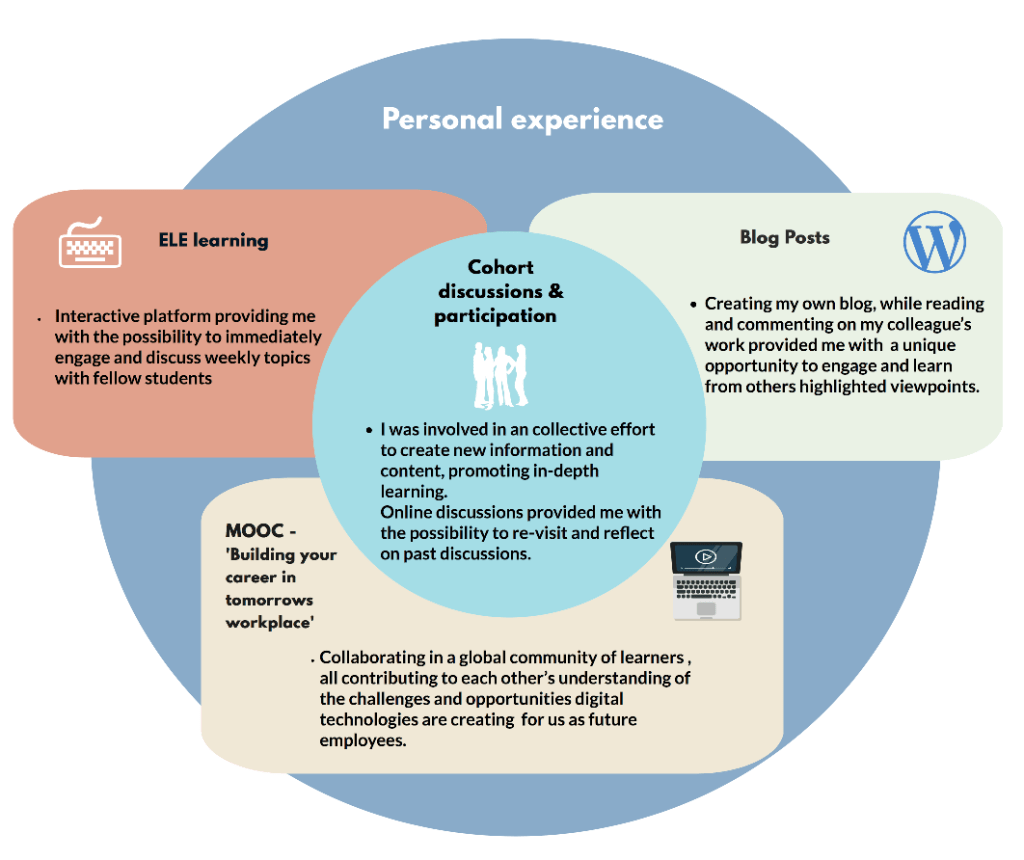
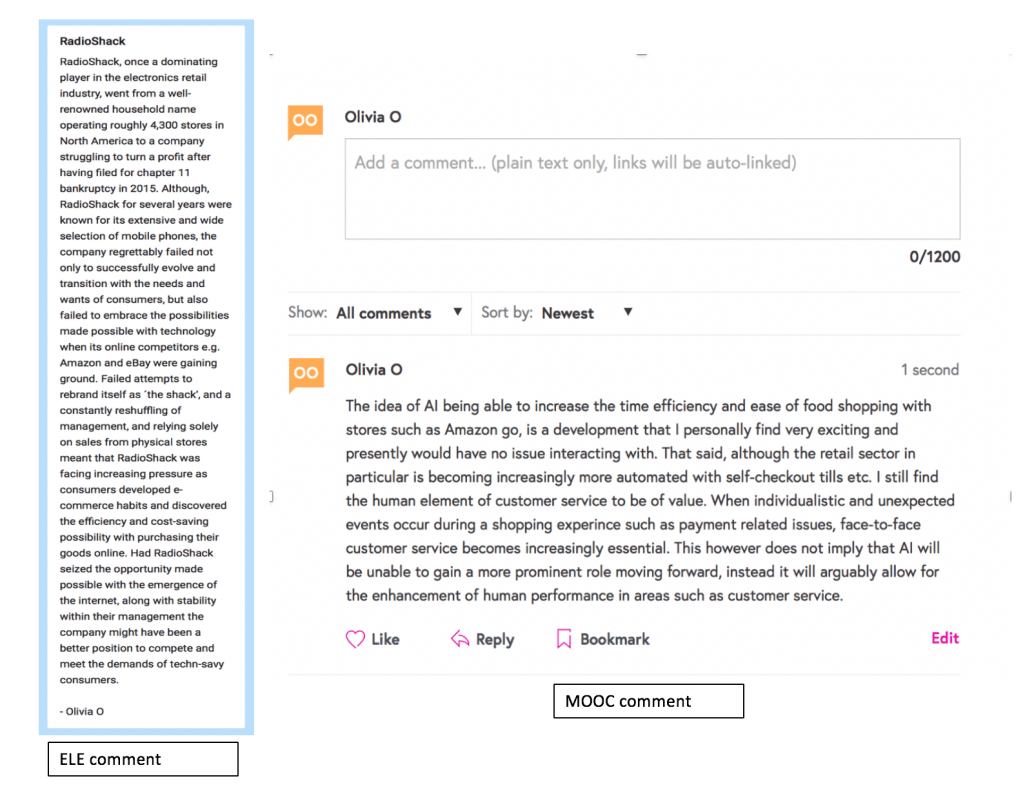
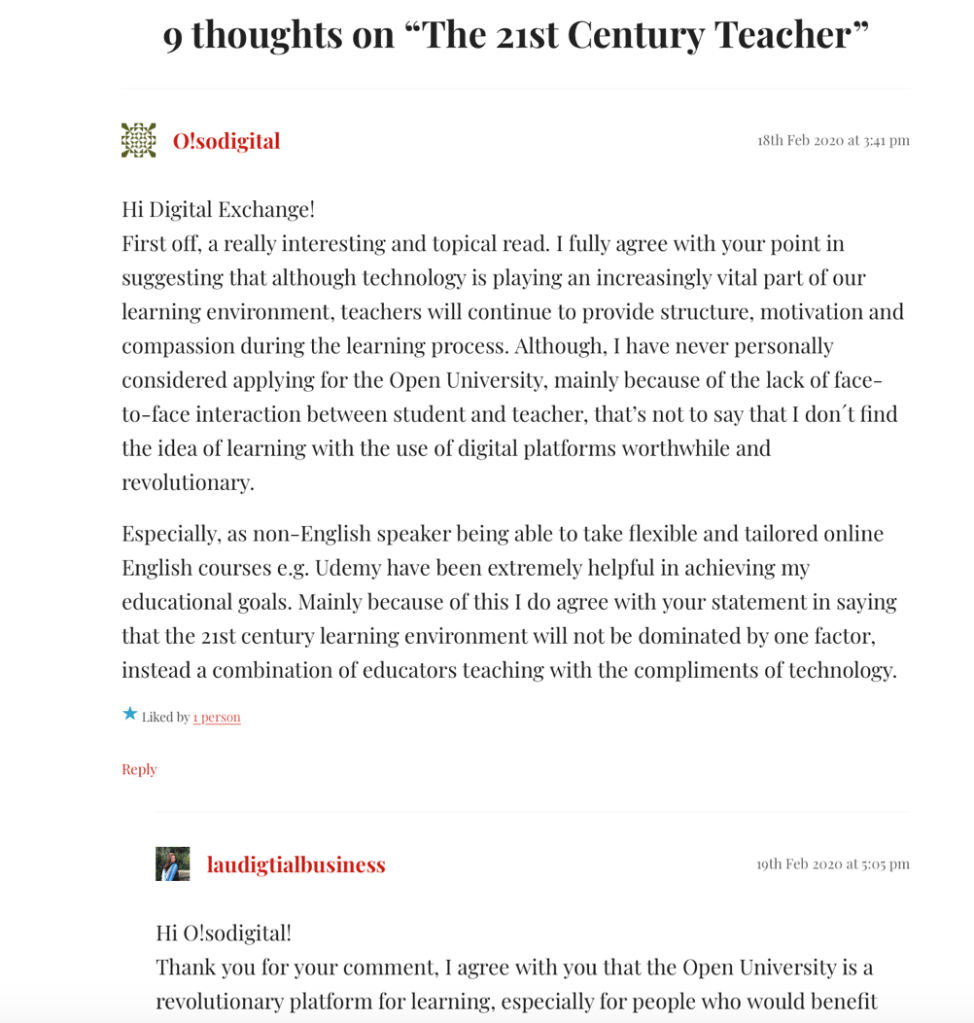
Learning online with the content provided on ELE and the two-week MOOC course, naturally encouraged me to be more an active learner. The combined effect of being asked content-related questions on a digital platform, with easy access to valuable information such as TED talks, reports, etc., subsequently allowed me to obtain various points of view on the module content. Examples 1 & 2 illustrate comments personally made to further contribute to the module content and learning experience.
Examples 1 & 2
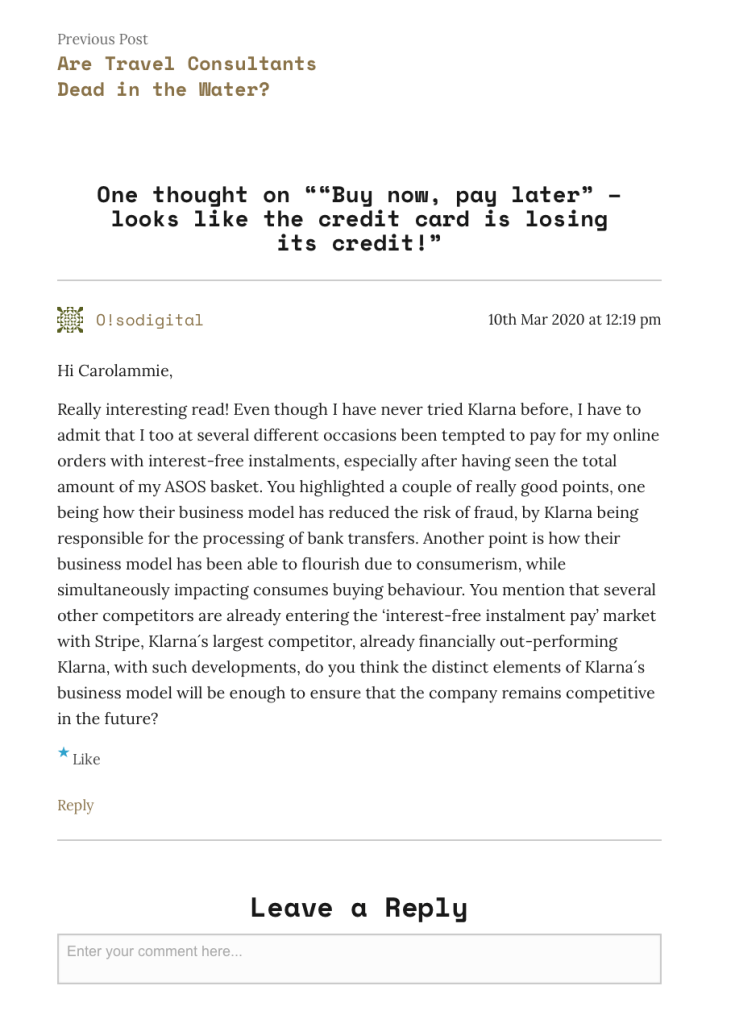
Collaborative learning with blog post comments
During our first assignment, we were asked to pick a job role and demonstrate how this particular role has changed and is expected to change further within the digital economy. While the Digital Exchange and Digitalhunt´s blog posts on the ‘21st century teacher’ and ‘Restaurants & robots’, provided me with a better understanding of how advances in technology are challenging the core job functions of teachers and waiters/waitresses, it also made me realize how the human element of these jobs will likely never be entirely replaced.
For our second assignment, we were then asked to identify a new business model and the aspects of that business model, making it a success. From Caro’s Digital business models blog and Green´s blog, I was able to read how the digital business models of Klarna and StichFix are essentially redefining how customers pay and shop retail online. The factor, however, identified as the source of their success has been the ability to process and accumulate a large amount of valuable customer data, an opportunity made possible only with the advances in digital technologies.
BEMM129´s impact on my future plans – what now?
In terms of moving forward, I have upon further reflection, determined several aspects in which I believe BEMM129 has significantly impacted my future plans with the attached video.
Has the combination of premeasured fresh ingredients, digitally customizable menu options, and home-delivery cracked the code of providing history´s most time-deprived generation with the ‘luxury’ of enjoying a homecooked meal? Yes, it would seem so!
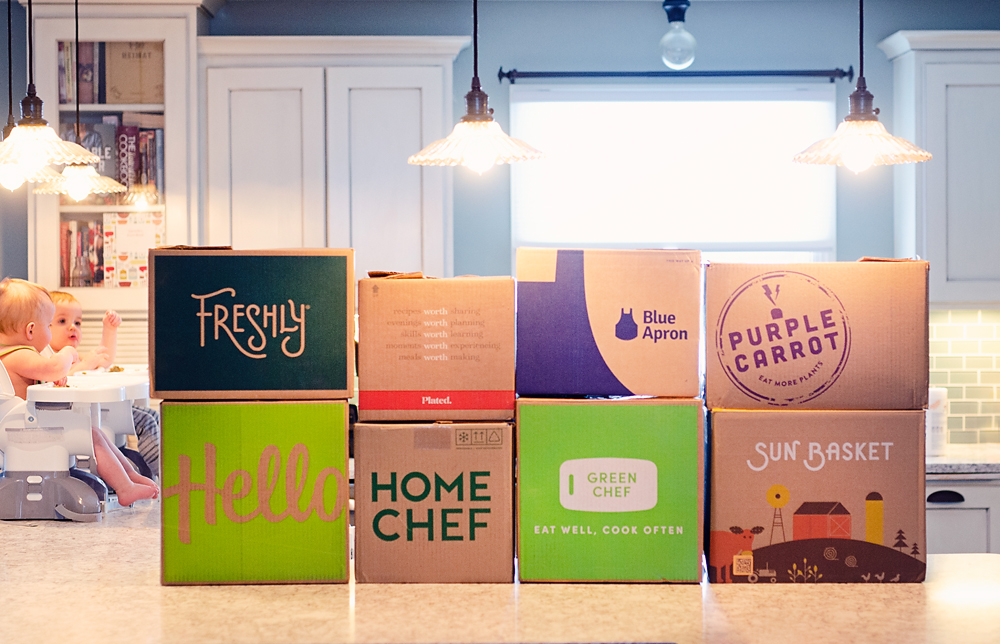
Does this scenario sound familiar; You’re really craving a healthy homecooked meal, but your busy schedule just doesn’t seem to allow you to get to the supermarket? Or maybe you do make the time, only to get to the supermarket and lack culinary inspiration? I know I have. Providing a possible solution for this time-dominated dilemma are meal-kits, a business venture proving extremely lucrative for companies successfully employing a hybrid physical/digital business model.
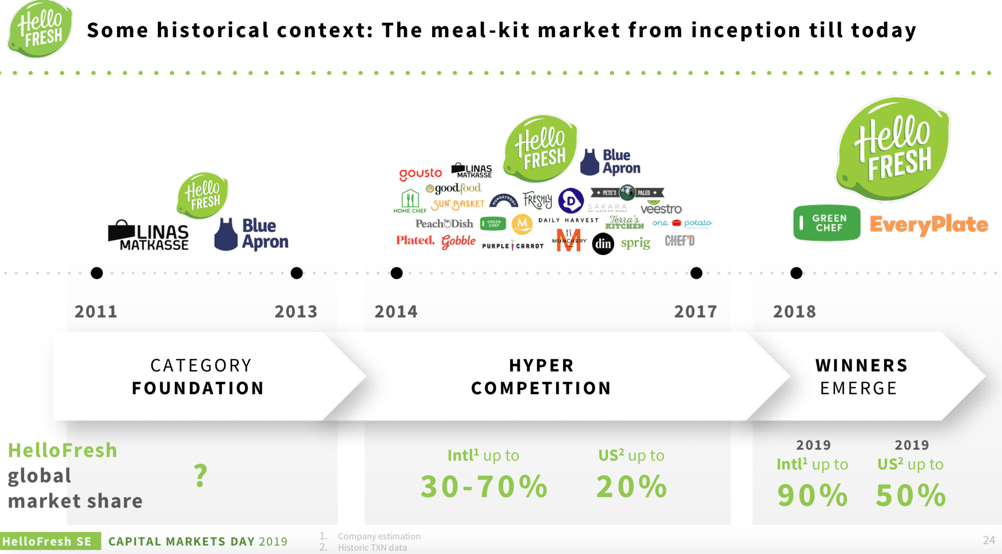
Although, the number of meal-kit companies employing a combination of a physical supply chain and a digital subscription platform has skyrocket in just the past few years, not all have proved a success. Between 2014 and 2017 venture capitalists invested more than $1billion into roughly 100 meal-kit startups with some drawing lines between its hyper competitive nature and the infamous dot com bubble (HelloFresh, 2019) (Image 1). Just as with the dot com bubble, only a few key players employed a business model with distinct capabilities successful enough to provide growth in an industry dominated by extremely large operating costs and a notoriously highly customer churn. One of these companies is German founded HelloFresh (Helm, 2018).
(Image 1) Retrieved from: HelloFresh (2019) Capital Markets Day
Launching in 2012, HelloFresh has been experiencing growth nothing short of impressive, from going public in 2017 (being valued at $1.9billion) (Helm, 2018), to now operating in 13 countries, distributing 68.9 million individual meal-kits to more than 2.61 million customers worldwide (in the year 2019)( Carpenter, 2019). Growth of this caliber has made HelloFresh the current market leader of a million-dollar industry disrupting one of the world’s largest industries; the global supply chain (Helm, 2018). With its weekly subscription options, HelloFresh is offering time-pressed customers like me the possibility to digitally customize their meals or providing automated meal recommendations before delivering them free of charge to their homes.
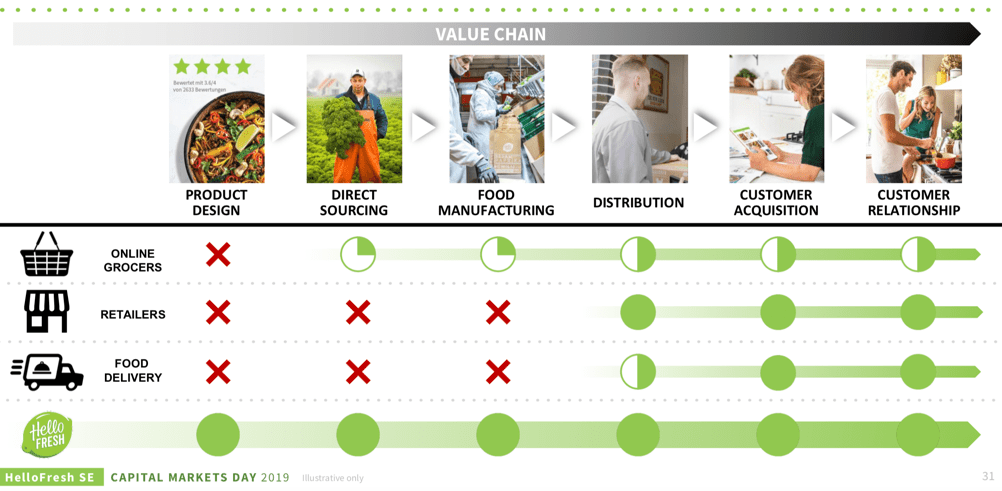
HelloFresh is remaining profitable in an industry with fast perishable produce, high overhead expenses, and a customer expectancy of competitively priced meal-kits containing high quality ingredients (Barseghian, 2019), by employing an aggressive direct-to-consumer supply chain (Image 2), one that is continuously and strategically being optimized with the customer data generated from their digital subscriptions (Stidham, 2019). While HelloFresh shares supply chain functions similar to the ones of traditional supermarkets, that being distribution, customer acquisition/relationships, the difference is found in the initial three steps prior to distribution. Within the initial phases of their supply chain HelloFresh undertakes recipe/product design, direct sourcing of fresh ingredients from suppliers, and food manufacturing and assembly in refrigerated warehouses by hundreds of employees in order to make their value propositions a reality (HelloFresh, 2019).
(Image 2) Retrieved from: HelloFresh (2019) Capital Markets Day
HelloFresh´s ability to thoroughly utilizes and implement their accumulated customer data has arguably not only led to the company´s competitive advantage but also its survival (Stidham, 2019). With years’ worth of accumulated customer data HelloFresh has been able to produce increasingly accurate demand forecasting algorithms, in return increasing the effectiveness and efficiency of their supply chain. Simply put, readily available customer data has become HelloFresh´s secret ingredient to success.
Moving forward this secret ingredient will likely prove even more beneficial and advantageous, seen as understanding individual consumers buying behavior and preferences may prove to be one of the only options in combatting a forecasted increase in meal-kit industry’s customer churn rate (Rajendran, 2017). Although, spending $30 million in marketing related activities (Helm, 2018) to acquire new customers indicates HelloFresh as being financially invested in establishing new customer relationships, it’s how these relationships will be maintained in the future will determine whether their customers become victims of ‘subscription fatigue´ (Robles, 2019).
According to Deloitte (2019) ‘Digital Media Trends’ survey consumers are experiencing ‘subscription fatigue’ as they grow more overwhelmed by the number of monthly subscriptions they are having to pay and the number of subscription service available today. I have to admit that there are times when I too find myself experiencing ‘subscription fatigue’, one example being the sheer number of subscriptions I need to make to watch my favorite TV shows or simply by the numerous different subscriptions I am having to pay every month.
Thus, one might argue that if HelloFresh´s hybrid digital business model is to successfully dominate within an increasingly fragmented market, Tien Tzuo (who coined the term ‘Subscription Economy’ (Luna, 2018)) suggests that customers’ needs to be looked at first before the product (Hyken, 2018). Working to create meaningful relationships with subscribers should remain the number one priority for companies employing a subscription-based revenue model, because according to Tzuo with meaningful customer relationships come loyalty, a commodity worth gold in an industry plagued by high churn rates and low switching costs.
On a final note, it is hard to imagine that HelloFresh would have been able to achieve its key player status within the meal-kit industy without taking advantage of aspects from both their physical and digital business models.
How dependent, as humans, have we become on the Internet? Have 21st century consumers grown so accustomed to digital automation and efficiency that we are willing to make one of life’s most important purchases, a home, without the intervention of a professional real estate agent?
A recently completed Futurelearn MOOC course ‘Building your Career in Tomorrow’s Workplace’ essentially sparked these questions. Its thought-provoking content highlighted that industry boundaries are blurring, as the specificity and nature of job skills required are continuously changing due to technology advancements. I think its safe to say, whether you are looking to secure a new job or already employed, technology has become particular disruptive to both these scenarios in requiring an evolving skill set (Accenture, 2017).
But what happens when technology allows for one set of job skill to becomes a substitute for another? This is the question 21st century real estate agents are facing with their future relevancy being questioned.
New homeowners relying solely on real estate agents to employ their expert market knowledge to either find or sell their home has arguably become a textbook or ´traditional´ homebuying scenario (Casselman et al., 2019).
In this day and age, homeowners looking to either sell or buy a new home are venturing down a rather different path during their homebuying/selling process, one which is not solely dictated by a real estate agent. Access to the internet has provided the average consumer with a significant increase in knowledge and influence, especially with regards to the homebuying process (Cherif et al., 2014).
Access to the Internet has undoubtedly provided the average consumer with a significant increase in knowledge and influence, especially with regards to the homebuying process.
Picture this; you have found a home with potential online, what is your next course of action? Most likely a google search to determine whether you like the neighborhood, previous past property evolution, crime statistics etc. all without actually viewing it in person (Black, 2019). This scenario having become such a natural phenomenon has brought into questioning several of a real estate agents core functions, threatening not only their commission but also their continued necessity during the homebuying process.
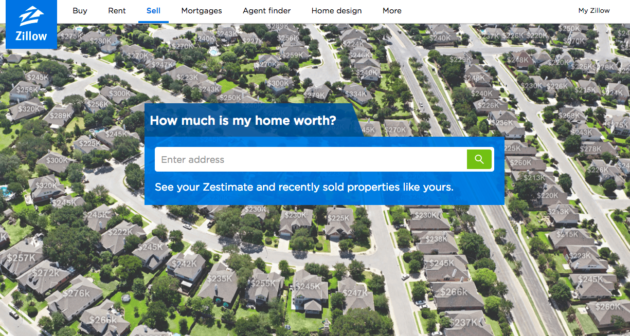
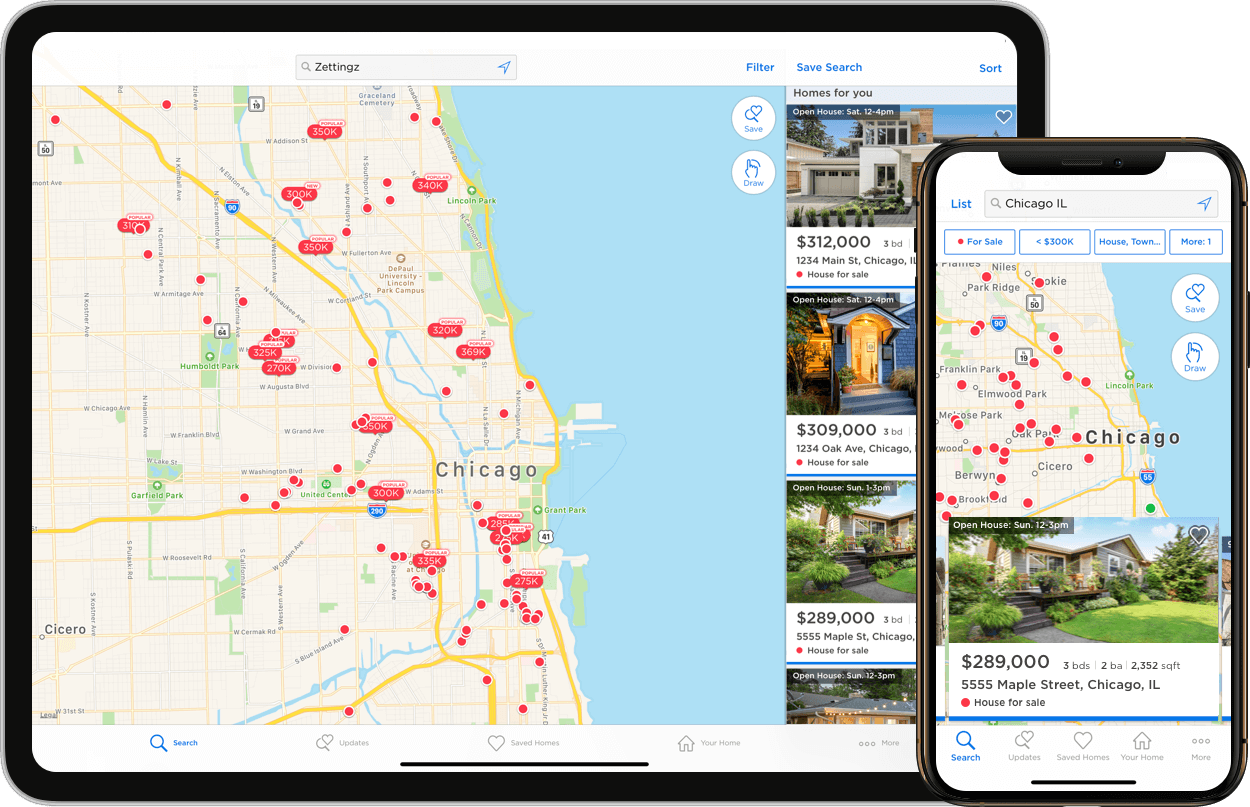
The untapped potential associated with the digital real estate market became increasingly apparent in 2018 when a recorded $2.7 billion was invested in real estate technology (Lyons, 2018). One company in particular who has taken great advantage of the opportunities made possible with digital technology has been US tech company Zillow. As a tech company Zillow is reshaping the role of real estate agents, by offering online functions such as virtual open houses or ‘Zestimate’ an online algorithm providing sellers with an instant property valuation (Casselman et al., 2019).
When all is said and done, these functions are arguably just minimizing the absolute necessity for a real estate agent, when the real threat has is tech companies such as Zillow having become licensed realtors with the ability to complete digital closing procedures. Abilities such as these have undoubtedly changed the necessity for a real estate agent, but whether they have entirely lost their future value is debatable.
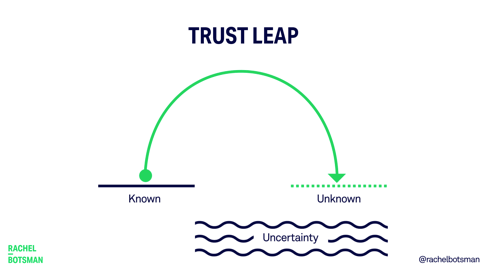
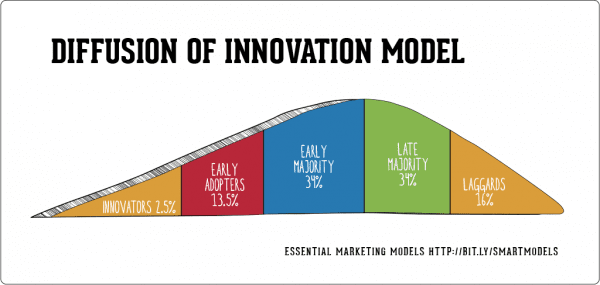
Although, computerization and automation is providing consumers with the option of undertaking their homebuying process with virtually no human contact, one might stop and question to what degree is this process to be trusted? Consumers are essentially trusting that an algorithm to correctly value a property and trust that all necessary details were disclosed in a legally binding contract. This act arguably requires not only a great deal of confidence but also the willingness to make what Botsman (2017) calls a ‘trust leap’. One might argue that the degree to which different customer groups are willing to embrace uncertainty and make a ‘trust leap’ into the unknown depends on their positioning in what Rogers (1962) defines as the ’Diffusion of innovation’.
Rogers (1962) argues that ‘innovators’ and ‘early adopters’, of which make up 16% of the diffusion curve, are given their adventuresome and willingness nature more likely to make a ‘trust leap’ with new technologies. While the 84%, are described as customers with a more reserved nature towards new technologies and may perceive the idea of involving a licensed professional with several years of experience as reassuring.
Although, a reality in which real estate agents would be able to make the homebuying process as efficient and convenient as a tech company is hard to imagine, however, that is not to say realtors do not possess the ability to reinvent themselves to become the link between technology and trust. If the next generation of relators are able to harness and utilize the possibilities of technology and combine them with the value of providing trust and navigation, it’s hard to imagine they will completely cease to exist in the future.
Cherif, E., & Grant, D. (2014). Analysis of e-business models in real estate. Electronic Commerce Research, 14(1), 25-50.
Lyons, B. (2018). Three predictions for the future of real estate tech. Retrieved fromhttps://www.forbes.com/sites/forbesrealestatecouncil/2018/12/10/three-predictions-for-the-future-of-real-estate-tech/
Rogers, E. M. (1962). Diffusion of innovations (1st ed.). New York: Free Press.
Hello! My name is Olivia. I am a Danish student originally from Copenhagen, Denmark, studying MSc Marketing at the University of Exeter. I completed the first two years of my BA in Marketing Management at Copenhagen Business Academy before moving to London to complete my final year of studying at the University of Greenwich.
Over the course of the next 11 weeks this blog will be dedicated to discussing and evaluating topics posed in the module of Digital Business Models. I have chosen to study this module based on my interest in further developing my understanding of the our current contemporary environment, one increasingly dominated by technology and digital businesses. Additionally, in undertaking this module I also hope to gain a better insight into the challenges and opportunities a future with changing employment requirements entails, and what this will mean not only for me as an aspiring 21st century marketer but also for the global environment as a whole.
Once again welcome to the O! So digital blog and please feel free to leave a comment.














 O! So digital