Has the combination of premeasured fresh ingredients, digitally customizable menu options, and home-delivery cracked the code of providing history´s most time-deprived generation with the ‘luxury’ of enjoying a homecooked meal? Yes, it would seem so!
Does this scenario sound familiar; You’re really craving a healthy homecooked meal, but your busy schedule just doesn’t seem to allow you to get to the supermarket? Or maybe you do make the time, only to get to the supermarket and lack culinary inspiration? I know I have. Providing a possible solution for this time-dominated dilemma are meal-kits, a business venture proving extremely lucrative for companies successfully employing a hybrid physical/digital business model.
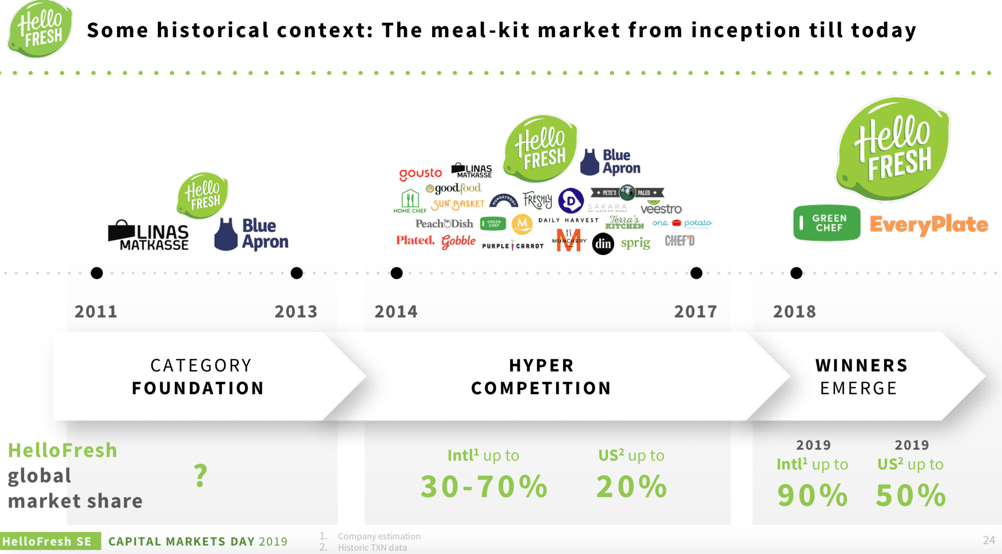
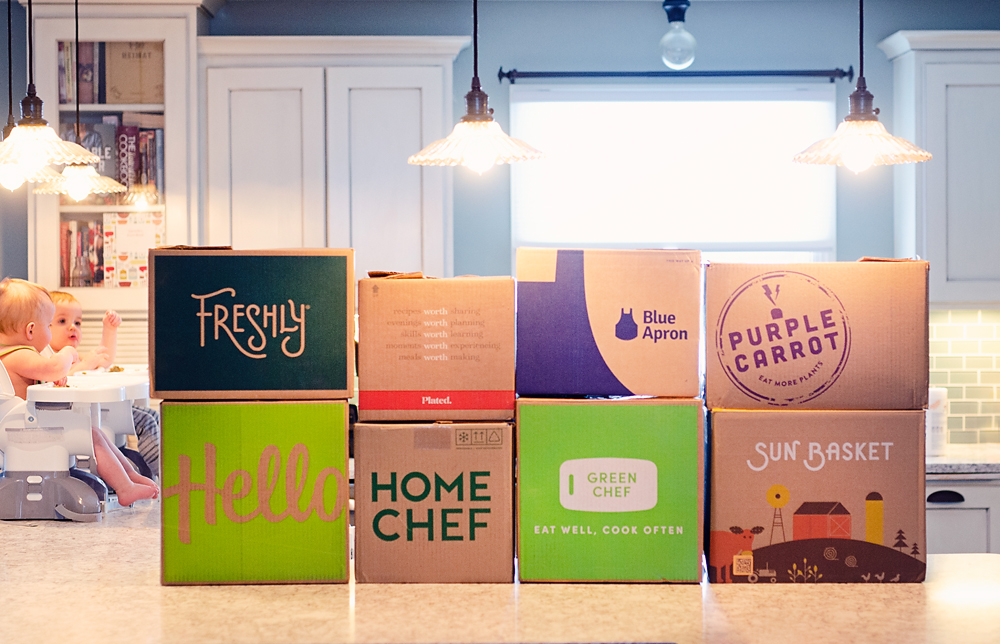
Although, the number of meal-kit companies employing a combination of a physical supply chain and a digital subscription platform has skyrocket in just the past few years, not all have proved a success. Between 2014 and 2017 venture capitalists invested more than $1billion into roughly 100 meal-kit startups with some drawing lines between its hyper competitive nature and the infamous dot com bubble (HelloFresh, 2019) (Image 1). Just as with the dot com bubble, only a few key players employed a business model with distinct capabilities successful enough to provide growth in an industry dominated by extremely large operating costs and a notoriously highly customer churn. One of these companies is German founded HelloFresh (Helm, 2018).
Launching in 2012, HelloFresh has been experiencing growth nothing short of impressive, from going public in 2017 (being valued at $1.9billion) (Helm, 2018), to now operating in 13 countries, distributing 68.9 million individual meal-kits to more than 2.61 million customers worldwide (in the year 2019)( Carpenter, 2019). Growth of this caliber has made HelloFresh the current market leader of a million-dollar industry disrupting one of the world’s largest industries; the global supply chain (Helm, 2018). With its weekly subscription options, HelloFresh is offering time-pressed customers like me the possibility to digitally customize their meals or providing automated meal recommendations before delivering them free of charge to their homes.

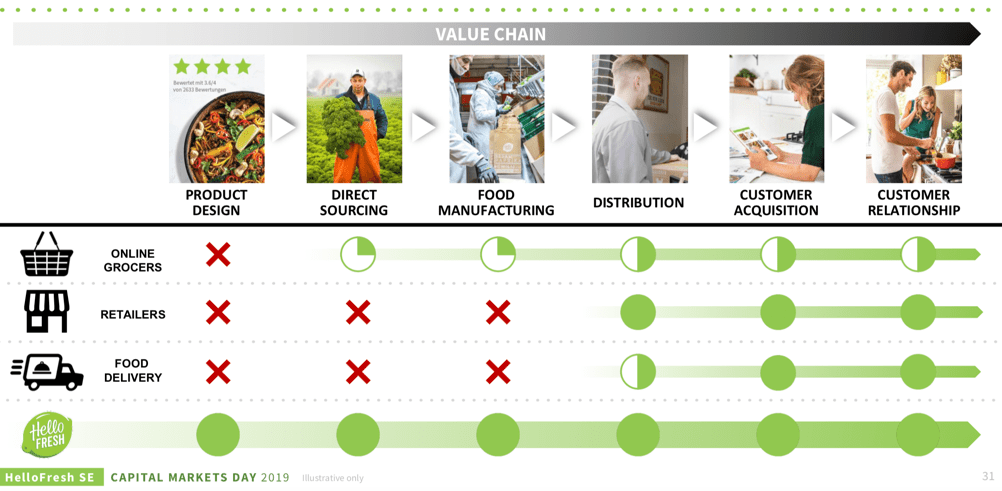
HelloFresh is remaining profitable in an industry with fast perishable produce, high overhead expenses, and a customer expectancy of competitively priced meal-kits containing high quality ingredients (Barseghian, 2019), by employing an aggressive direct-to-consumer supply chain (Image 2), one that is continuously and strategically being optimized with the customer data generated from their digital subscriptions (Stidham, 2019). While HelloFresh shares supply chain functions similar to the ones of traditional supermarkets, that being distribution, customer acquisition/relationships, the difference is found in the initial three steps prior to distribution. Within the initial phases of their supply chain HelloFresh undertakes recipe/product design, direct sourcing of fresh ingredients from suppliers, and food manufacturing and assembly in refrigerated warehouses by hundreds of employees in order to make their value propositions a reality (HelloFresh, 2019).
HelloFresh´s ability to thoroughly utilizes and implement their accumulated customer data has arguably not only led to the company´s competitive advantage but also its survival (Stidham, 2019). With years’ worth of accumulated customer data HelloFresh has been able to produce increasingly accurate demand forecasting algorithms, in return increasing the effectiveness and efficiency of their supply chain. Simply put, readily available customer data has become HelloFresh´s secret ingredient to success.
Moving forward this secret ingredient will likely prove even more beneficial and advantageous, seen as understanding individual consumers buying behavior and preferences may prove to be one of the only options in combatting a forecasted increase in meal-kit industry’s customer churn rate (Rajendran, 2017). Although, spending $30 million in marketing related activities (Helm, 2018) to acquire new customers indicates HelloFresh as being financially invested in establishing new customer relationships, it’s how these relationships will be maintained in the future will determine whether their customers become victims of ‘subscription fatigue´ (Robles, 2019).
According to Deloitte (2019) ‘Digital Media Trends’ survey consumers are experiencing ‘subscription fatigue’ as they grow more overwhelmed by the number of monthly subscriptions they are having to pay and the number of subscription service available today. I have to admit that there are times when I too find myself experiencing ‘subscription fatigue’, one example being the sheer number of subscriptions I need to make to watch my favorite TV shows or simply by the numerous different subscriptions I am having to pay every month.

Thus, one might argue that if HelloFresh´s hybrid digital business model is to successfully dominate within an increasingly fragmented market, Tien Tzuo (who coined the term ‘Subscription Economy’ (Luna, 2018)) suggests that customers’ needs to be looked at first before the product (Hyken, 2018). Working to create meaningful relationships with subscribers should remain the number one priority for companies employing a subscription-based revenue model, because according to Tzuo with meaningful customer relationships come loyalty, a commodity worth gold in an industry plagued by high churn rates and low switching costs.
On a final note, it is hard to imagine that HelloFresh would have been able to achieve its key player status within the meal-kit industy without taking advantage of aspects from both their physical and digital business models.
Reference List:
- Barseghian, w. (2019). What´s behind the rise of the subscription model? Retrieved 4 March from https://www.forbes.com/sites/forbestechcouncil/2019/08/12/whats-behind-the-rise-of-the-subscription-model/
- Carpenter, W. (2019). HelloFresh review: Is it worth it? Retrieved 4 March from https://www.investopedia.com/articles/personal-finance/021316/hellofresh-review-it-worth-it.asp
- Deloitte (2019). Digital media trends: a look beyond generations. Retrieved 4 March from https://www2.deloitte.com/us/en/insights/industry/technology/digital-media-trends-consumption-habits-survey/video-streaming-wars-redrawing-battle-lines.html
- HelloFresh (2019). Capital Markets Day. Retrieved 4 March from https://www.hellofreshgroup.com/download/companies/hellofresh/Presentations/CMD_2019_WEBSITE.pdf
- Helm, B. (2018). The worlds most ruthless food startup: the inside story of how HelloFresh clawed its way to the top. Retrieved 4 March from https://www.inc.com/magazine/201808/burt-helm/hellofresh.html
- Hyken, S. (2018). Is a subscription model in your company´s future? It had better be!. Retrieved 4 March from https://www.forbes.com/sites/shephyken/2018/11/25/is-a-subscription-model-in-your-companys-future-it-had-better-be/
- Luna, J. (2018). Why every business will soon be a subscription business. Retrieved 4 March from https://www.gsb.stanford.edu/insights/why-every-business-will-soon-be-subscription-business
- Rajendran, V. (2017). Meal-Kit companies and their retention challenges. Retrieved 4 March from https://medium.com/@vaishnavirajendran/meal-kit-companies-and-their-retention-challenges-f7c286a8e3d3
- Robles, P. (2019). How can companies prepare for subscription fatigue? Here are five ways. Retrieved 4 March from https://econsultancy.com/how-companies-can-prepare-subscription-fatigue/
- Stidham, K. (2019). How HelloFresh is using data to create a more efficient supply chain. Retrieved 4 March from https://www.mytotalretail.com/article/how-hellofresh-using-data-create-more-efficient-supply-chain/
 O! So digital
Really interesting post! I personally have always wanted to try hellofresh and think it is a great business that has utilised the digital space well to accommodate convenience. You said that their success is down to the physical and digital spaces, which do you think is most important? If hello fresh did not have a great product then there would be no returning customers, so would you say that the physical needs to be accepted in order to facilitate the digital space to become so successful?
LikeLike
Hi Hannah, Thanks for the comment!
That’s a really good question, although I ultimately think it would have to be a combination of both, it is plausible to argue, as you suggested that the physical product is what ignites the HelloFresh supply chain. If HelloFresh fails to meet customer expectations, in terms of fresh and high-quality products, it would not be hard to imagine that their customer retention rate would decrease along with the volume of valuable accumulated customer data. That said, however, I do believe that without their ability to ship, package and effectively coordinate their supply chain with the use of their digital space, HelloFresh would have a slim chance of reaching a competitive advantage in a market with high competitive rivalry.
LikeLike
Hi Olivia! Thank you for this interesting post. I like the way you tell this story- by combining your personally feelings and experience you create a vivid picture for reader about what is HelloFresh and what can it provide for customers. I also like the image you provide in the post. For example, image 2 provides information about how HelloFresh works and what is its competitive advantages very clearly. You also provide valuable opinions about sustainable development. My favorite point about this post is that you highlight HelloFresh’s unique advantage in a very clear way- the idea of utilizing available customers data to provide customized culinary inspiration is very inspiring. Good job!
However, I would like to learn more about HelloFresh’s physical business presence. I am not very clear about how can the physical part contribute to the successful business?
LikeLike
Hi Olivia!
I was not familiar with HelloFresh but I have heard of other companies with a similar offer, showing indeed how fierce the competition can be in these new industries.
As you mentioned, I think that in the digital age, more than acquisition, retention is key to remain profitable in the long run. In my case for instance, I would probably try the service once to experience something new but I definitely would not subscribe for long, unless it is really good value for money. Differentiation will be therefore of foremost importance for a sustainable competitive advantage.
What do you think HelloFresh could do to differentiate its offer even more in the future?
I am thinking maybe of integrating organic products to recipes or of partnering with chefs. I suppose HelloFresh could also take advantage of digitalization to automate the supply chain, to produce more cost-effectively.
LikeLike